
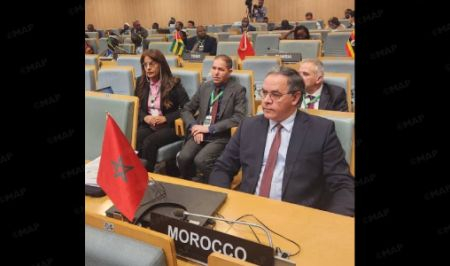
Morocco’s initiatives for food security in Africa were highlighted, on Friday before the Ministerial Segment of the 6th ordinary session of the African Union’s (AU) Specialized Technical Committee on Agriculture, Rural Development, Water and Environment (STC-ARDWE).
Morocco’s permanent representative to the AU and UN-ECA, Mohamed Arrouchi, emphasized that the Kingdom has made Africa’s food security a strategic priority, integrated into its socio-economic development programs, mainly the National Strategy “Green Generation 2020-2030,” recalling the launch of several concrete initiatives and key actions for food security within the framework of Agenda 2030, Agenda 2063, and various multilateral initiatives.
In this regard, the diplomat cited the call for the creation of an international fund dedicated to food security in Africa, on the occasion of the second review of the United Nations Food Systems Summit (UNFSS+4), the launch in 2016 of the African Agriculture Adaptation Initiative (AAA) and the Initiative for Sustainability, Stability and Security in Africa (Triple S).
He also highlighted the Kingdom’s commitment, through the tripartite partnership between the OCP Group, AUDA-NEPAD, and the AU Commission signed in 2019, and the opening by OCP of 12 representative offices on the continent to strengthen fertilizer production and distribution.
He noted that the OCP Group has also donated thousands of tons of fertilizer to several African countries, an action that is part of Morocco’s solidarity and concern for African farmers.
Arrouchi also emphasized that this session is being held at a pivotal moment for the continent, marked by the transition from the Malabo Declaration (2014–2025) to the new Kampala Strategy and Action Plan (2026–2035), noting that the Kingdom welcomes and fully supports the African initiatives launched in this context, particularly through the sustainable transformation of African agri-food systems and the strengthening of resilience to climate change.
The diplomat also highlighted Morocco’s achievement of the highest score in the 2023-2025 STC-ARDWE cycle, demonstrating the country’s ongoing efforts in this area.
He emphasized that this performance illustrates the vision of King Mohammed VI, who has placed agriculture at the center of the Kingdom’s economic and social development.
As part of its active solidarity and unwavering policy in favor of South-South complementarity, and in light of the many challenges facing the continent, Morocco reaffirms its full readiness to cooperate actively with the African Union Commission, the Regional Economic Communities, and all member states to translate the guidelines of the Kampala Vision into concrete actions, he said, assuring that the Kingdom will continue to defend the values of solidarity, unity, and partnership that underpin joint action.
“Together, let us work for an Africa that produces and feeds its population, while sustainably preserving its natural resources for the benefit of future generations,” he concluded.
The Ministerial Segment, organized by the AU’s Department of Agriculture, Rural Development, Blue Economy, and Sustainable Environment, was preceded by a session of experts and senior officials on October 21-22.
The main objective of the meeting is to review and recommend to the AU Executive Council the main policy and operational documents relating to agriculture, rural development, water, and the environment.
This involves reviewing and validating the report on the implementation of the recommendations and decisions of the 5th STC-ARDWE and reviewing and approving the progress report on ongoing programs and projects in order to update previous decisions and declarations.