
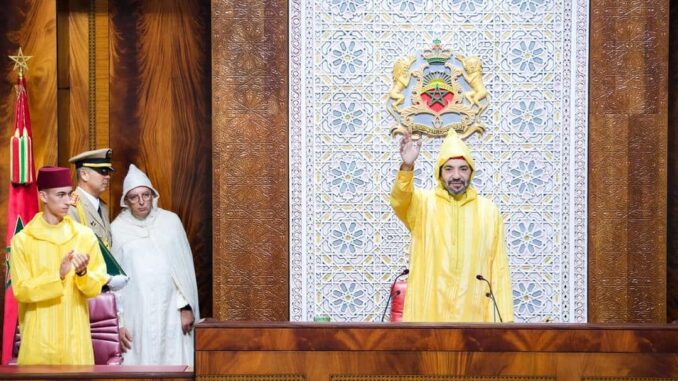
The new legislative and governmental term is expected to be a real turning point in advancing Morocco’s ambition as a rising, dependable economic power, King Mohammed VI said in a speech he delivered on Friday while chairing the opening of the first session of the first legislative year of the 12th Legislature, stressing the need to make sure to strike a balance between economic growth and greater social and territorial equity.
In a world characterized by rapidly accelerating geo-economic shifts, Morocco – guided by a clear vision – has embarked on a new wave of reforms and major projects, the King underlined.
Today, in addition to accelerating the implementation of planned infrastructure projects, the Sovereign emphasized that a new generation of major strategies must be launched, particularly in the fields of water, energy, and food security, industrial takeoff, the digital economy, and artificial intelligence.
The King reiterated his call to accelerate the development of the Kingdom’s capabilities in the field of strategic reserves and to secure the supply of basic commodities.
In this regard, he urged the private sector to step up and become a strategic player in the Kingdom’s development transformation, to show greater initiative and a keener innovative spirit, and to increase its capacity to create jobs, invest, and export.
The Sovereign noted, in this respect, that it is particularly important to make sure youth issues are at the forefront of public policies and of the agenda of governance bodies through the formulation of a comprehensive vision guaranteeing equal opportunities and encompassing education, skills development, and economic integration.
“This approach aims to bolster young people’s confidence in the prospects for social advancement, in their nation’s institutions, as well as in the opportunities provided to build a better future – one that guarantees freedom, dignity, and stability,” the King insisted.
The King pointed out that the real challenge for the coming period also lies in fieldwork, at the local level, to identify the actual problems facing each region and come up with realistic solutions to them.
He highlighted in this connection that advancing integrated development, improving public services, and bolstering productive investment are inextricably linked to the process of advanced regionalization and administrative de-concentration.
“However, the delays and deficiencies that continue to hinder the implementation of decentralization and administrative de-concentration are adversely affecting economic and social development programs and are impeding the response to citizens’ real concerns,” the King pointed out.
“Any further delay or procrastination in the full implementation of the de-concentration charter is unacceptable. The reference here is to the required transfer of competencies, and of the necessary human and financial resources, from the central government to the provinces and regions,” the Sovereign stated further, stressing the need to put an end to the obstacles that continue to hinder the work of regional institutions, particularly through a clearer definition of their competencies and the provision of greater human and material resources.
In this connection, the Sovereign called for regulating the relationship between the State and the Regions, and to establish mechanisms for coordination and contracting in order to enable the Regions to make decisions and implement projects.
The King, who recalled that the parliamentary mandate is a political commitment and a moral contract binding the PMs to the citizens, urged them to live up to this national responsibility that they bear before God, the citizens and history.