
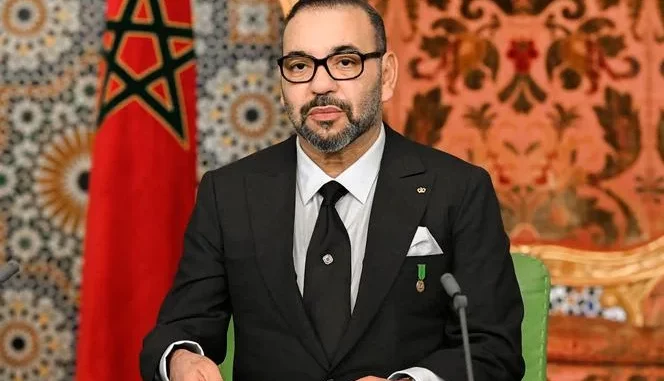
King Mohammed VI chaired this Wednesday at the Royal Palace in Rabat a working session devoted to assessing the progress of the Nador West Med port complex, whose first terminal is set to enter into service in the upcoming days, as well as to the extension project of the Tanger Med complex, where the works of the new Tanger Med 3 port are about to be launched.
During this meeting, which is part of the working sessions chaired by the Monarch and dedicated to the developments of the major national ports projects, a presentation was made before the Sovereign by Chairman of TMSA’s Oversight Board, Chairman of the Nador West Med Board of Administration, on the state of progress of the two projects and the next steps in their development, said the Royal Office in a Statement.
These two new projects are part of the Royal Vision to equip Morocco with an efficient port system capable of strengthening its competitiveness in the face of the restructuring of global value chains. This ambition combines national growth with regional development through a more equitable distribution of public investment, the mobilization of private capital, and the creation of job opportunities. It should also result in tangible benefits for residents of neighboring areas while ensuring that value creation is rooted in local communities.
Nador West Med (NWM) is set to complete the Tanger Med offer and bolster Morocco’s logistical, industrial, and energy positioning. Combining port infrastructure and industrial, logistical, and energy platforms, the project has to date mobilized 54 billion dirhams of public and private investment.
Its first container terminal, whose initial phase will soon enter into service, will ultimately offer a capacity of 3.5 million containers. A second terminal, with a capacity of 1.8 million containers, will enter into service in April 2027. These two terminals will mobilize 8 billion dirhams in private investment, the statement said.
The energy component provides for the commissioning of the hydrocarbon terminal, backed by a storage area with a potential capacity of 4 million m3, as well as a liquefied natural gas terminal capable of processing up to 5 billion m3 per year. These investments are part of the consolidation of the Kingdom’s energy security in line with the royal instructions.
This offer will be completed by a terminal for solid bulk and another for general cargo.
As for the industrial zone, which is already operational, it currently hosts one active factory while three others are under construction. It will open up new opportunities for business and professional integration. In the short term, the NWM complex will create 14,000 direct and 20,000 indirect jobs.
This momentum is supported by the development of connecting infrastructure, notably the Selouane-NWM railway link, the Guercif-NWM highway, and the upgrading of the road network, the aim being to better serve the surrounding territories.
At the same time, the Tanger Med extension project, presented before the Monarch, will strengthen the capacities of this port complex, with the imminent planned launch of the works of the Tanger Med 3. Located to the west of Tanger Med 2, this new port, requiring an investment of 8 billion dirhams, will include 1,200 meters of quays, for an additional capacity of 4.5 million containers per year.
A concession contract has been signed with Maersk-APM, one of the world leaders in maritime transport, for the development of the new container terminal. This development is also accompanied by the ongoing extension of the passenger and roll-on/roll-off port and will enable the eastern extension of Tanger Med 2.
With the completion of these new projects, the Tanger-Med port complex could reach a total capacity of 20 million containers, allowing it to position itself in the global top 10.
After the presentations, King Mohammed VI stressed the imperative that the economic and social benefits of these projects reach all the provinces concerned and translate into tangible improvements for local populations. In this context, the Monarch called for the accelerated implementation of training programs tailored to the needs of emerging activities to promote the professional integration of the youth, the statement added.