
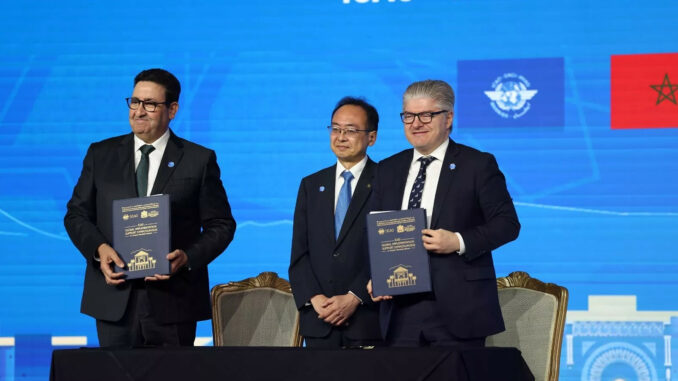
Morocco’s Minister of Transport and Logistics Abdessamad Kayouh held a series of meetings on April 14 with transport ministers and senior officials from international aviation bodies, signing agreements aimed at deepening cooperation and exchanging expertise in civil aviation.
The talks took place on the sidelines of the fifth Global Implementation Support Symposium for Civil Aviation in Marrakesh.
Speaking to reporters after the meetings, Kayouh said he had discussed bilateral aviation ties with Angolan Transport Minister Ricardo de Abreu, including the possibility of expanding air links between Luanda and Casablanca.
Royal Air Maroc is working on developing the route and could increase weekly flights to two or three services, Kayouh said. He added that the airline was also studying the deployment of new aircraft it is due to receive in the coming months.
Kayouh said discussions with Angola also covered maritime connectivity, noting that a sea link between the two countries is expected to be launched following the opening of Morocco’s Dakhla Atlantic Port, which would connect Angola with the kingdom.
The minister said he also met the secretary‑general of the African Civil Aviation Commission (AFCAC), during which the two sides signed an agreement under which Morocco will provide training for African air navigation technicians.
The initiative aims to strengthen aviation safety indicators across the continent, a move he said aligns with Morocco’s longstanding cooperation policy toward African countries.
Kayouh said Morocco signed an air services agreement with Costa Rica granting third and fourth freedom rights for air routes between the two countries. He also held talks with Yemen’s transport minister focused on aviation cooperation, reaffirming Morocco’s commitment to activating a previously signed agreement once conditions allow.
Beyond bilateral accords, Morocco is pursuing an ambitious strategy to position itself as a leading aviation hub between Africa, Europe and the Americas. Under its “Airports 2030” program, the government aims to increase national airport capacity to around 80 million passengers by 2030, up from roughly 30 million, through new terminals, airport expansions and the construction of a second major airport in Casablanca, officials have said.
The expansion is being matched by a major growth plan at flag carrier Royal Air Maroc, which operates about 50 aircraft today and plans to expand its fleet to around 200 planes by 2037 under a long‑term performance contract signed with the state.
The strategy is designed to turn Casablanca’s Mohammed V Airport into a major intercontinental hub and strengthen Morocco’s role as an air bridge linking Africa with global markets, the government has said.