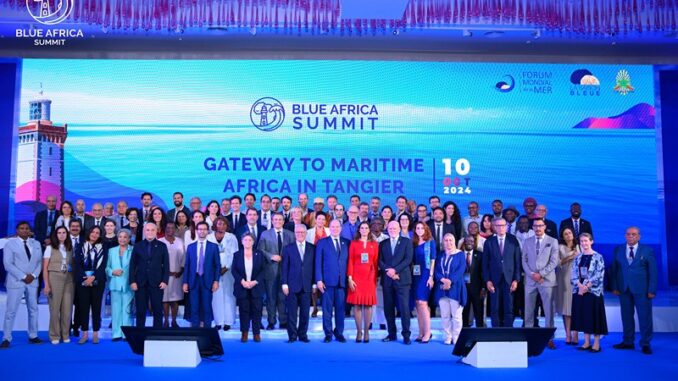
The fourth Blue Africa Summit, held this week in Tangier to advance ocean governance and maritime development, highlighted by the official unveiling of the Africa Blue Compass (ABC), a strategic roadmap developed over the course of one year by 300 experts from across the continent.
The roadmap establishes an operational framework for strengthening Africa’s maritime sovereignty through several key pillars, including marine governance, the development of port infrastructure, maritime transport and connectivity corridors, the sustainable use of marine resources, scientific research and the mobilization of funding.
It calls on stakeholders to swiftly implement its recommendations “to accelerate the development of a sustainable blue economy, by and across the African continent.”
Speaking at the event, co-organized by the Academy of the Kingdom of Morocco, the World Ocean Forum and La Saison Bleue, Minister in Charge of Maritime Fisheries Ahmed El Mehdi Mezouari stressed that the ocean must become a source of prosperity, food security and solidarity for Africa. He noted that the success of this ambition should be measured by its tangible impact on people’s living conditions, particularly fishing professionals, families and young people seeking employment opportunities.
The minister pointed out that Africa’s maritime heritage faces several challenges, including climate change, pollution and illegal fishing, compounded by inadequate infrastructure, limited local processing capacity and insufficient financing.
In response to these challenges, he called for stronger cooperation, greater knowledge-sharing and increased investment in youth skills, while emphasizing the importance of ensuring that African scientific expertise plays a central role in decisions concerning the continent’s maritime future.
Mezouari also highlighted Morocco’s commitment to Atlantic solidarity and shared prosperity across Africa. He recalled that the Royal Initiative to facilitate Sahel countries’ access to the Atlantic Ocean reflects this royal vision, adding that Morocco is determined to contribute to this momentum by leveraging its experience, infrastructure and partnerships.
For his part, Permanent Secretary of the Academy of the kingdom of Morocco Abdeljalil Lahjomri stressed that “Africa should not merely have a place in the global ocean economy; it must also have a voice in shaping global thinking on the oceans.” He emphasized the need for the continent to define its own approaches to understanding, protecting and harnessing its maritime resources.
Addressing the significance of the Africa Blue Compass (ABC), Lahjomri described the initiative as a strategic compass placing the ocean at the heart of Africa’s future. He explained that it seeks to bring together experts, policymakers, the private sector and civil society around a shared vision, transforming the continent’s maritime wealth into opportunities for development, innovation and resilience.
In this regard, he announced the Academy’s project to establish a “Chair of Blue Humanities,” dedicated to aquatic environments and environmental humanities. The initiative aims to foster dialogue between science, technology, economics and politics, on the one hand, and the humanities, literature and the arts, on the other.
Lahjomri also called for the memories, narratives and knowledge of coastal communities to be taken into account at the earliest stages of decision-making on maritime projects. He argued that collective memory serves as an essential diagnostic and decision-making tool for ensuring genuinely sustainable development.
President of La Saison Bleue Rym Benzina addressed Africa’s representation on world maps, which has long been diminished by the Mercator projection. She stressed that Africa no longer wants to remain “merely on the sidelines of global decision-making,” but instead seeks to become “one of the centers of gravity” in decisions concerning the oceans.
Benzina also highlighted the ambition behind the Africa Blue Compass, the result of a year of collective work, which aims to move beyond strategic planning and translate its vision into concrete action. She outlined the summit’s main program priorities, including science and knowledge-sharing, cooperation and financing for blue investments, as well as efforts to combat plastic pollution in Africa and the Mediterranean.
For his part, President of the World Ocean Forum, Bizerte Pascal Lamy noted that Africa, with its 38 coastal states and approximately 13 million square kilometers of exclusive economic zones, must strengthen its participation in international ocean governance. He highlighted the need for better coordination of African positions and the development of the continent’s scientific and technical capabilities.
Welcoming the presentation of the ABC, Lamy said in a video message that the roadmap should help strengthen Africa’s scientific autonomy and address the continent’s knowledge gap regarding the oceans. He called for the development of concrete, bankable projects supported by financing mechanisms bringing together public institutions and private investors.
In the same vein, France’s Ambassador for the Poles and Maritime Issues, Olivier Poivre d’Arvor, described the ABC as an operational roadmap designed to help Africa better harness the potential of its blue economy. He said the initiative outlines concrete measures to support the development of maritime activities across the continent, stressing the need to move beyond strategic guidelines and focus on their implementation.
He also highlighted Morocco’s role in mobilizing African countries around ocean governance, particularly commending its commitment to ratifying the High Seas Treaty.
During the two-day summit, discussions also addressed the deployment of the Neptune Mission Academy in Morocco, the progress and future prospects of the United Nations Task Force, efforts to promote a plastic-free Africa, as well as women’s leadership and innovation.
Discussions showcased Morocco’s blue economy model, which falls within the framework of the Royal Atlantic Vision and is notably supported by the Tanger Med and Dakhla Atlantique port hubs.
The summit concluded with a forward-looking session entitled “Heading Towards 2027: Atlantic Cooperation.”