
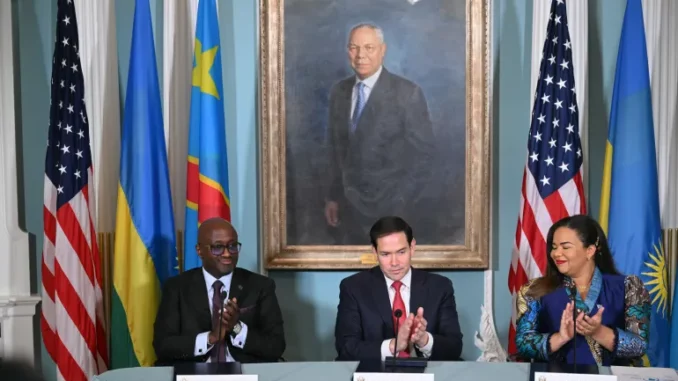
Rwanda and the Democratic Republic of Congo held the first meeting of a joint international oversight committee on Thursday in Washington, a step forward in implementing a peace agreement signed in April, Reuters reported. The committee includes the African Union, Qatar, and the United States, and is tasked with overseeing implementation and resolving disputes tied to the June deal.
The agreement, brokered by US President Donald Trump’s administration, outlined a 90-day plan for Rwandan troop withdrawal from eastern Congo. It also mandated the creation of a joint security coordination mechanism within 30 days and the implementation of a plan to monitor the withdrawal within three months. Congo’s military campaign against the Democratic Forces for the Liberation of Rwanda (FDLR), a rebel group with ties to the 1994 Rwandan genocide, was also expected to wrap up in that same window.
But 30 days after the deal was signed, however, the joint security mechanism has not convened. There has also been no movement yet to withdraw Rwandan troops or military operations against the FDLR.
Despite that, the joint oversight meeting was held on schedule, within the 45-day window outlined in the accord.
When asked about the delays in troop withdrawal and anti-FDLR operations, Trump’s senior Africa adviser Massad Boulos denied that the deal has been derailed. “There was no timeline for that,” he said. “If you look at the chronology of what we’ve been able to do since April, it’s been extensive, and it’s been very much on point and very much in line with our aspirations. So it’s not off track in any way.”
Sources familiar with the talks acknowledged the delays but said they do not threaten the deal. Military and diplomatic sources told Reuters that the conflict parties, including the M23 rebel group and local militia groups
known as Wazalendo (“patriots”), have reinforced their positions along the front lines.
Tensions between Rwanda and the DR of Congo have simmered for decades, rooted in the aftermath of the 1994 Rwandan genocide and the complex web of rebel activity in eastern Congo.
After the genocide, thousands of perpetrators and Hutu militias fled into eastern Congo, forming the FDLR. Kigali views the group as a persistent security threat. Over the years, the FDLR has clashed with Congolese forces and rival militias, fueling instability in the mineral-rich Kivu provinces.
Rwanda has been repeatedly accused of backing the M23 rebel group, which claims to defend Tutsi interests and has launched multiple offensives in eastern Congo. Kigali denies supporting M23, but UN experts and several Western governments have provided evidence linking Rwandan forces to the group’s operations.
In response, Congo’s President Félix Tshisekedi’s government has aligned with the Wazalendo and deepened military ties with countries including Burundi and Angola. The conflict has displaced over seven million people, according to the UN, and disrupted access to vital resources such as cobalt, tantalum, and gold, metals critical to global supply chains for batteries and electronics.
The June 2025 Washington deal followed months of behind-the-scenes talks led by the US, amid concerns that the regional crisis could escalate further. While the agreement includes security and military commitments, its real test lies in its implementation—something that has long proved elusive in this volatile region.