
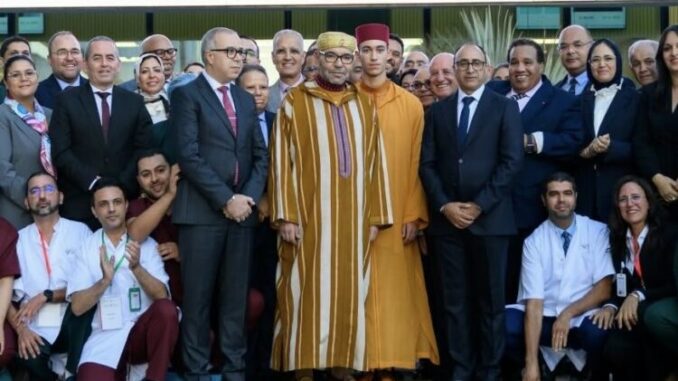
King Mohammed VI accompanied by Crown Prince Moulay El Hassan, inaugurated on Monday the Mohammed VI International University Hospital Complex of Rabat, a facility offering cutting-edge nationwide services for all, along with a high-level training in healthcare professions.
On the same day, the Sovereign has issued instructions to put into service the Mohammed VI University Hospital Center of Agadir, considered a landmark medical pole poised to make a great stride in healthcare services and doctor training in the Souss-Massa region.
The Mohammed VI International University Hospital Complex of Rabat, established by the Mohammed VI Foundation for Sciences and Health, stands as a genuine emblem of a new-era modern and smart health infrastructure, and reflects the ambition to provide all citizens with equitable access to next-generation healthcare services, with a hospital facility that integrates the most advanced medical innovations and a university facility of reference and research.
It also attests to the key role attached by the Sovereign to human resources training in this vital sector, as well as his determination to grant them high-quality training, in line with the scientific and technological developments as regards treatment, prevention, management and healthcare governance, in accordance with international standards.
Spanning a 280,000 m² surface area, the Complex encompasses two complementary facilities: The Mohammed VI International University Hospital of Rabat (190,000 m²) and the Mohammed VI University of Science and Health (90,000 m²).
A patient-centered next-generation facility
With an initial 600-bed capacity, which can be extended to 1000, the Mohammed VI University Hospital-Rabat englobes more than 30 medical surgical and medical technical poles of excellence, covering specialties such as robotic surgery, neurosurgery, interventional cardiology, oncology, radiotherapy, as well as cutting-edge imaging.
This hospital counts, among others, more than 24 ultramodern surgery rooms, including 19 concentrated within an integrated operating unit covering a global 3,400 m² area, hybrid and robotic rooms, as well as 143 intensive care beds, including 30 neonatal incubators.
The facility is equipped with state-of-the-art technology, including PET-MRI, a first in Morocco and Africa, combined with PET-SCAN for high-precision diagnosis. It is also equipped with 3T Omega MRI, the Ethos Hypersight radiotherapy system, a robotic hospital pharmacy, and a simulation center.
Among the innovative services, it is worth mentioning the burn unit and the hyperbaric and hypobaric oxygen therapy service -the only service of this kind in Morocco intended for advanced medical treatments and physiological research.
In addition, the Complex has the first laboratory platform fully automated in Africa, covering all stages of chemical analysis, immunology and hematology, from pre-analysis, analysis and post-analysis. It has the only anatomical pathology digitalized lab in Morocco, offering traceability and high precision diagnosis.
Patient-focused, the Mohammed VI International University Hospital-Rabat proposes integrated and customized care paths, ensuring comfort, security and quality. The facility is also considered a privileged learning platform for the Mohammed VI University of Sciences and Health students, enabling them an immersive experience in clinical and top-tier technology environments.
A genuine academic pole of excellence, the Mohammed VI University of Sciences and Health-Rabat is due to contribute to strengthening one of the strategic pillars of the healthcare system’s reform, namely the human capital.
The university has 15 lecture halls with a total capacity of 4,000, 72 classrooms, and 217 rooms for practical and supervised work. This educational facility, with a capacity of up to 8,000 students, has several colleges and schools: Mohammed VI Faculty of Medicine – Rabat, Mohammed VI Faculty of Dentistry, Mohammed VI Faculty of Pharmacy, Mohammed VI School of Veterinary Medicine, Mohammed VI Higher School of Health Sciences, Mohammed VI Faculty of Nursing Sciences and Health Professions. An international medical simulation center complements this system, providing students with hands-on training in an environment that simulates real-life professional conditions.
The complex, committed to a sustainability approach, is certified HQE (High Quality Environmental standard) at the “Exceptional” level. It is equipped with 8,800 m² of photovoltaic panels that cover more than 10% of its energy needs and reduce its carbon emissions by 40%.
Agadir Mohammed VI CHU, genuine symbol of modernity
As for the Mohammed VI University Hospital Center of Agadir, it was built on a 30-hectare site (127,000 m² indoors), located near the Faculty of Medicine and Pharmacy.
With an investment of around MAD 3.1 billion, the new CHU, with a total capacity of 867 beds, includes several poles (mother-and-child, medical-surgical, radiology, cardiology, etc.), a central operating block (19 rooms), additional 5 emergency rooms and rooms for burn victims, a laboratory, a central pharmacy, and an integrated training and simulation system.
A true symbol of modernity, Agadir CHU is the first facility in Africa to integrate surgical robot “Revo I”, allowing minimally invasive interventions with micrometric precision, high-definition 3D vision and providing unprecedented operational comfort for surgeons and patients.
With two cardiac catheterization rooms and intensive care units equipped with multi-parameter monitors, the cardiology pole of the new CHU ensures the full care of patients with coronary illnesses and heart arrhythmia. The equipment, which complies with international standards, enables angioplasty, electrophysiology exploration, and high-resolution intravascular imaging to be performed.
Similarly, to guarantee patient safety and quality of care, the Mohammed VI University Hospital of Agadir is equipped with a full sterilization Center (washer-disinfectors, saturated steam autoclaves, and automated packaging areas ensuring the traceability of instruments), as well as a central pharmacy with a medication dispensing robot, guaranteeing secure preparation and automated delivery to hospital departments, a first in the region.
As a next-generation reference hospital, this project, which will benefit around 3 million people, will contribute to the development of hospital infrastructure in the Souss-Massa region and to strengthening healthcare services, bringing them closer to citizens who will no longer need to travel to other cities for complex surgeries or certain difficult pathologies.
These two large hospital facilities will generate thousands of direct and indirect jobs, contributing to economic and social development at both regional and national levels.