
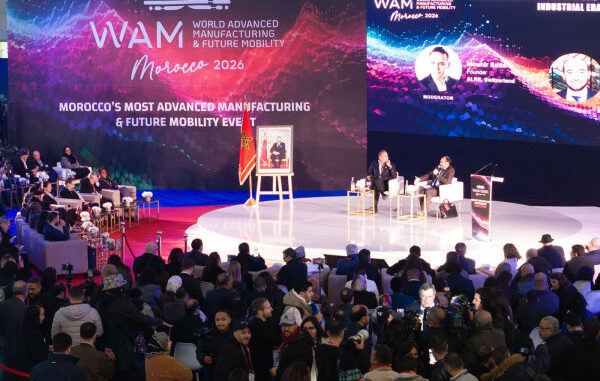
Casablanca is hosting the inaugural World Advanced Manufacturing & Future Mobility Exhibition Morocco (WAM) through January 22, bringing together Industry 4.0 leaders, digital experts, and policymakers to explore how artificial intelligence can accelerate economic transformation in emerging markets. The event has sparked intense discussions about future mobility, industrial innovation, and the strategic opportunities that advanced technologies present for developing economies.
Artificial intelligence emerged as a central theme throughout the exhibition, with speakers emphasizing its potential as a catalyst for growth when backed by early and targeted investment. Mounir Sada, founder of AI-Ré, a company specializing in geopolitical risk assessment through AI solutions, argued that countries investing in AI today will secure decisive competitive advantages tomorrow. He stressed that nations like Morocco need not compete in developing large language models alongside global tech giants. Instead, existing technological resources already enable the creation of applications tailored to local realities and the specific needs of governments and businesses.
Morocco’s AI development remains in its early stages, supported primarily by startups, university research centers, and a handful of major corporations often partnering with foreign entities. The government has set an ambitious target of adding $10 billion to GDP through AI implementation by 2030, hoping to create skilled employment and establish the country as a leading technology hub in Africa.
The WAM Morocco exhibition has attracted over 100 exhibitors from more than 18 countries, including the United States, France, Spain, Portugal, Italy, the Netherlands, Saudi Arabia, the UAE, and Vietnam. Major international corporations such as SAP, Sumitomo Corporation, ENGIE, Vigel, and Zoho Corporation are participating in a Moroccan manufacturing exhibition for the first time, signaling growing interest in the country’s industrial value chains.
Mehdi Snene, head of the UN’s AI and digital program, highlighted the global dimensions of AI governance, comparing its challenges to climate change and noting the recent adoption of the Global Digital Compact, the first multilateral agreement establishing a common framework for digital and AI governance. Redouane El Haloui, president of Morocco’s information technology and telecommunications federation, emphasized that AI cannot reach its full potential without coherent digital strategy and rigorous data management.