
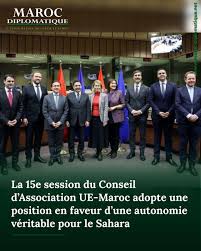
The 15th EU-Morocco Association Council session concluded Thursday in Brussels with a significant shift in European position regarding Moroccan Sahara. The 27 EU member states now consider that “genuine autonomy could represent one of the most achievable solutions” for definitively resolving the regional dispute.
This position by all EU member states appeared in a joint communiqué signed by Foreign Minister Nasser Bourita and EU High Representative for Foreign Affairs and Security Policy Kaja Kallas following the association council session. The 27-nation bloc adopted the UN Security Council’s call for all parties “to participate in discussions without preconditions and based on Morocco’s proposed autonomy plan to reach a definitive political solution.”
The EU “welcomed” Morocco’s willingness “to clarify how autonomy within the framework of Moroccan sovereignty would be implemented,” the joint communiqué states. Additionally, the EU “welcomed the adoption of UN Security Council Resolution 2797 (2025) which fully supports the Secretary General and his Personal Envoy’s efforts to facilitate and conduct negotiations based on Morocco’s proposed autonomy plan.”
While numerous European Union countries had already provided strong support for Sahara’s Moroccan identity and Morocco’s proposed autonomy plan, this new EU position marks a fundamental advancement. It aligns with the international momentum driven by King Mohammed VI favoring Sahara’s Moroccan identity and supporting the autonomy initiative, crowned by the UN Security Council’s adoption of Resolution 2797 on October 31, 2025.
The new European position reflects the 27 EU member states’ consensus favoring definitive resolution of this regional dispute based on autonomy under Moroccan sovereignty. This achievement should undoubtedly provide new impetus to future bilateral relations and milestones, particularly regarding the forthcoming strategic partnership between both parties. The development represents diplomatic momentum building across international institutions supporting Morocco’s position on its southern provinces.