
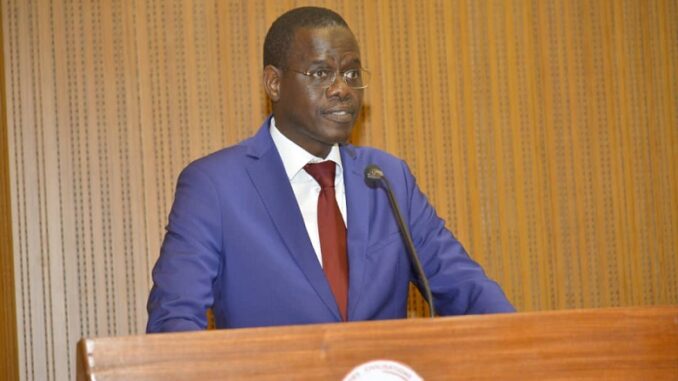
Senegalese Prime Minister Ahmadou Al Aminou Lô has defended plans to renegotiate the country’s debt and pursue an agreement with the International Monetary Fund (IMF), amid strong opposition from lawmakers aligned with National Assembly President Ousmane Sonko.
Presenting his government’s policy roadmap to Parliament on Tuesday, Mr Lô acknowledged Senegal’s difficult economic position, citing a debt level of 132% and widespread poverty affecting about eight million people, or 40% of the population. “We are a poor country currently heavily indebted,” he said, arguing that the government could not ignore the scale of the economic crisis.
The Prime Minister said Senegal’s economy grew by 2.2% in 2025, below its population growth rate of 3%. He attributed the worsening situation to lower-than-expected tax revenue and an oil price shock linked to the war in Iran. According to him, the government has little choice but to restructure the country’s debt and negotiate with creditors.
Mr Lô also defended efforts to secure an IMF-supported programme, explaining that measures expected under such an arrangement—including tax reforms and better-targeted subsidies—were consistent with Pastef’s economic recovery plan. “Autarky does not exist; we need foreigners,” he said. “We need to reconnect with the international community and the IMF. We are members of the IMF.”
He assured lawmakers that negotiations would not compromise Senegal’s national interest or lead to severe austerity measures similar to those implemented during the 1980s.
The Government, he said, would protect social expenditure while rationalising public finances and continuing the Senegal 2050 development programme initiated by President Bassirou Diomaye Faye and Mr Sonko.
However, at least 54 Pastef lawmakers publicly challenged the Prime Minister’s approach, particularly his decision to renegotiate the national debt instead of continuing tax reforms initiated under Mr Sonko. Some lawmakers accused the government of yielding to the demands of the IMF and international financial interests.
Pastef MP El Hadji Ousmane Fall said the roadmap contained inconsistencies, while Moustapha Sarré, a special adviser to Mr Sonko, warned that debt restructuring could undermine Senegal’s sovereignty. The Takku Wallu coalition, associated with former President Macky Sall, also criticised the policy statement, arguing that it offered no clear new direction or concrete commitments.
Mr Sonko, who concluded the eight-hour parliamentary debate, said all international agreements, including any deal with the IMF, would be subjected to parliamentary scrutiny. He did not comment on the possibility of a no-confidence motion against the government.