
International recognition of Morocco’s sovereignty over its entire Sahara and its Autonomy plan endorsed by the UN Security Council Resolution 2797 is gaining momentum by the day.
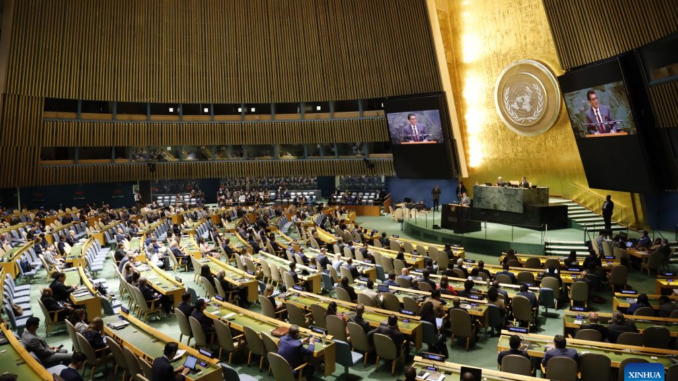
This was evidenced Monday in New York during separate meetings held by Moroccan Foreign Minister Nasser Bourita with a number of his peers taking part in the 81st session of the UN General Assembly unfolding this September 8 to 28.
In this connection, the foreign ministers of Chile, Panama and Cape Verde have all expressed support to Morocco’s sovereignty and its autonomy plan for the Sahara.
In a joint statement issued following the meeting held between Bourita and Chilean peer Francisco Pérez Mackenna, Santiago expressed “support for the sovereignty of the Kingdom over its entire territory, including the Sahara region,” saying the Autonomy plan proposed by Morocco in 2007 offers a “just, lasting, and mutually acceptable political solution.”
Chile lauded UNSC Resolution 2797/2025, urging the parties to the Sahara conflict to engage in negotiations without preconditions on the basis of Morocco’s autonomy proposal with a view to reaching a lasting and mutually acceptable political solution.
For his part, Panama FM Javier Eduardo Martínez-Acha Vásquez expressed his country’s steadfast backing to Morocco’s full sovereignty over its entire Saharan territory and described the autonomy proposed by the Kingdom in 2007 as the ONLY serious, credible and realistic basis for achieving enduring political solution to this regional dispute.
He also affirmed that Panama’s embassy in the Kingdom extends its consular jurisdiction to the Moroccan Sahara. Panama hailed on this occasion the momentum driven by UNSC Resolution 2797, which adopted the Moroccan autonomy plan in the Sahara under the Kingdom’s sovereignty.
The same position has been voiced by Foreign Minister of Cape Verde Manuel Augusto Lima Amante da Rosa in a joint press release issued following his talks with Moroccan peer Nasser Bourita.
Mr. Lima Amante da Rosa has reaffirmed his country’s support for Morocco’s sovereignty over its entire territory, including the Sahara, labelling Morocco’s autonomy plan as the ONLY realistic and feasible solution.
He also commended the royal leadership and initiatives aimed at promoting peace, stability and shared prosperity in Africa, citing in this regard the Atlantic African States Initiative and the Royal Initiative for landlocked Sahel countries.
Bourita, for his part, thanked Cape Verde for its unwavering backing to the Moroccanness of the Sahara and expressed Rabat’s readiness to support this African country development in priority sectors, including health, tourism, fisheries, agriculture, blue economy, and green energy.
Bourita also conferred with his Honduran counterpart, Mireya Agüero de Corrales, whose country decided last April to suspend its recognition of the self-proclaimed Sahrawi Republic.
The two sides discussed issues of common and regional interest, as well as ways to strengthen bilateral cooperation between Rabat and Tegucigalpa.
In the same vein, ways to promote cooperation between Morocco and Uganda were at the center of talks between Bourita, and his Ugandan counterpart, Adonia Ayebare. Thery also reviewed ways of supporting the development of the African continent and exchanged views on regional and international issues of common interest.
The same day, Bourita met with the High Representative of the European Union for Foreign Affairs and Security Policy and Vice-President of the European Commission, Kaja Kallas.
During the meeting, the two officials commended the positive momentum characterizing the two sides’ relationship since the 15th Association Council held on January 29, 2026, and the High Representative’s working visit to Rabat last April.
They also reaffirmed their shared determination to capitalize on this momentum to further advance all aspects of their comprehensive partnership, built on more than fifty years of cooperation, and elevate it to an even more strategic level.
Earlier in the day, Bourita participated in a high-level event organized by the Gulf Cooperation Council on “The Challenges Posed by Non-State Armed Groups.”
He reaffirmed Morocco’s firm condemnation of such groups, highlighted their growing sophistication and cross-border reach, and pointed to the severe impact in Africa, where nearly 24,000 deaths have been linked to violence by armed groups over the past year.
He specifically condemned Houthi attacks on Saudi Arabia, Iranian actions targeting GCC stability, and threats to freedom of navigation.
Bourita also met U.S. Congressman Joe Wilson, co-chair of the Congressional Morocco Caucus.