
Morocco is consolidating its position as an automotive power. The sector’s share of national exports rose from 25.1% in 2015 to 34.68% at the end of August 2026, with sales abroad grew 14.5% to MAD 116.14 billion. The kingdom is Africa’s leading vehicle producer and exporter, relying on an integrated industrial ecosystem and an installed capacity of around one million vehicles.
Total Moroccan exports more than doubled in ten years, from MAD 218 billion in 2015 to MAD 470 billion in 2025, according to the Foreign Exchange Office’s annual trade report. Automotive exports grew 191.3% to MAD 159.2 billion, adding MAD 104.6 billion in export revenue, or 41.5% of the total increase. The sector now outranks phosphates and derivatives (MAD 99.8 billion) and agrifood (MAD 86.83 billion).
In 2023, sales jumped 28.3% to MAD 149.7 billion while overall exports rose just 0.37%. The sector then stalled in 2025, slipping 0.2% as national exports gained 3%. Figures to end-August 2026 confirm a recovery: car construction rose 19% to MAD 44.74 billion, wiring 13.9% to MAD 44.77 billion and the exterior segment 43.6% to MAD 3.76 billion.
In 2024 Morocco became the continent’s top vehicle producer for the first time, with nearly 614,000 units against about 591,000 for South Africa, according to Fitch Solutions. Renault operates in Casablanca and Tangier, Stellantis in Kenitra. In 2025 Morocco exported 454,443 vehicles against 414,271 for South Africa, and exports 90.53% of its output, with Europe absorbing about 80% of shipments.
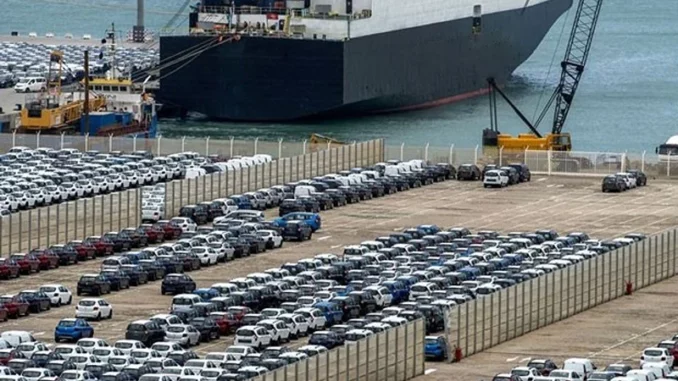
The port of Tanger Med is central to this system: in 2025 its two vehicle terminals handled 327,569 Renault and 126,874 Stellantis vehicles. France remains the top market for passenger cars at MAD 16.54 billion, or 28%, ahead of Italy (14.5%), Spain (11.5%), Germany (8.9%) and Turkey (6.3%).