
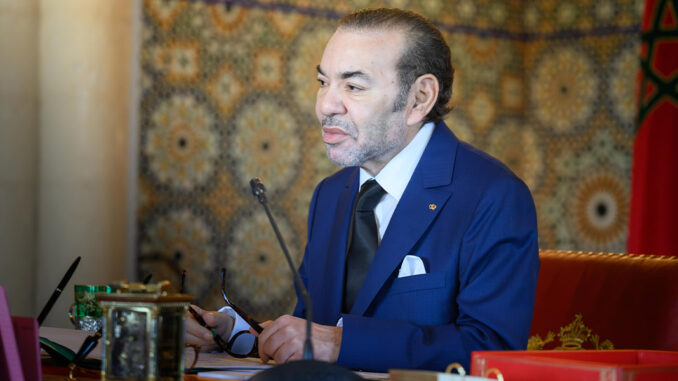
King Mohammed VI presided over a Council of Ministers at the Royal Palace in Rabat this Thursday 9 April 2026, during which the government unveiled a landmark new generation of integrated territorial development programs backed by an estimated investment of 210 billion dirhams over eight years.
The council also addressed an exceptionally strong agricultural season, adopted 15 international conventions, approved two organic bills, and made a series of senior appointments in the health sector.
The territorial development framework was presented by Interior Minister Abdelouafi Laftit. Its conceptual departure from previous approaches lies in its methodology: rather than projecting priorities downward from the capital, the new generation of programs is built upward from locally expressed citizens’ needs across all provinces and prefectures of the Kingdom. Diagnostic studies have been conducted territory by territory, measuring socioeconomic indicators and identifying gaps in access to employment, healthcare, education, water supply and infrastructure. The budget of approximately 210 billion dirhams will be deployed over eight years to close those gaps with precision.
The governance architecture is equally innovative. At the local level, committees presided over by provincial governors — composed of elected representatives and deconcentrated state services — will design and monitor their programs. At the regional level, the wali will harmonize programs across provinces. National coordination will be assured by a committee under the Prime Minister, responsible for securing financing and overall coherence. Regional Execution Agencies (AREP) will be transformed into public limited companies to combine governance rigor with management flexibility, and a digital platform will allow citizens to track implementation in real time.
The agricultural briefing that opened the session painted an exceptionally positive picture. Rainfall this season averaged 520 millimeters nationwide — 54 percent above the 30-year mean — driving dam reserves to 12.8 billion cubic meters. Olive production reached a record 2 million tons, up 111 percent year on year; citrus output rose 25 percent to 1.9 million tons; and date production increased 55 percent to 160,000 tons. The King also received assurances that pasture regeneration is supporting the reconstitution of the national livestock herd.
The council adopted 15 international conventions, including bilateral agreements on air transport, judicial cooperation, customs and military training, and four multilateral accords — among them an agreement establishing a regional African cybersecurity incident response center in Morocco. Five directors general of territorial health groupings (GST) were also appointed, accelerating the governance reform of Morocco’s primary care network across Casablanca-Settat, Rabat-Salé-Kénitra, Fès-Meknès, Laâyoune-Sakia El Hamra and Souss-Massa.