
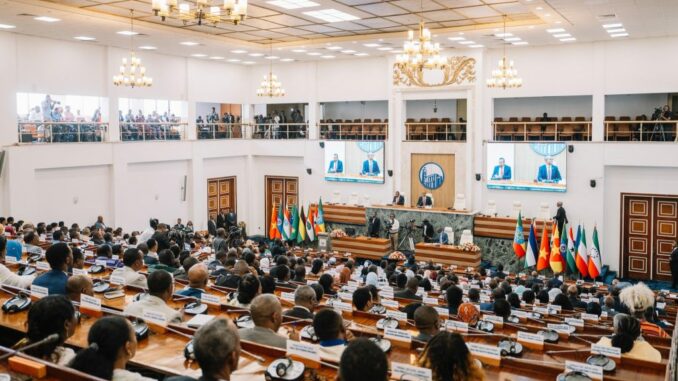
In a decisive legislative move underscoring Ethiopia’s development diplomacy and fiscal mobilization strategy, the House of People’s Representatives has approved on Thursday, June 4, new loan agreements aimed at reinforcing pastoral livelihoods and expanding national social protection systems.
The agreements, concluded between the Government of Ethiopia and the African Development Bank, alongside the International Development Association, are set to finance the Pastoral Community Food and Livelihood Improvement Project as well as the sixth phase of the Productive Safety Net Programme.
The session, held during the House’s 23rd regular sitting, received a detailed briefing from Government Chief Whip Tesfaye Beljige, who outlined the strategic intent and financial architecture underpinning both instruments. Lawmakers subsequently ratified the bills, signalling broad parliamentary endorsement.
According to the presentation, the African Development Bank facility—valued at approximately 71.94 million US dollars—will scale up ongoing interventions across 30 selected woredas. The financing is designed to deepen resilience among pastoral communities increasingly exposed to climate volatility, while expanding critical rural infrastructure.
Planned interventions include water development systems, veterinary services, sustainable land management frameworks, agribusiness support, renewable energy deployment, and the expansion of meteorological monitoring stations. The facility was described as highly concessional, featuring an interest-free structure, a 10-year grace period, and a 40-year maturity profile.
Officials further emphasised that the programme aligns with Ethiopia’s broader macroeconomic debt sustainability strategy while simultaneously reinforcing climate adaptation capacity and rural transformation objectives.
In parallel, the International Development Association-backed initiative will advance the next phase of the Productive Safety Net Programme, targeting food-insecure households across 494 woredas in twelve regional states and one city administration. The government reaffirmed its long-term objective of transitioning vulnerable populations from dependency towards sustainable, productivity-driven livelihoods.
In synthesis, the parliamentary approval reflects a calibrated policy direction—where development financing, climate resilience, and social protection converge into a unified national growth architecture—projecting Ethiopia’s rural transformation agenda into its next operational phase. The agreements were formally enacted following parliamentary deliberations.