
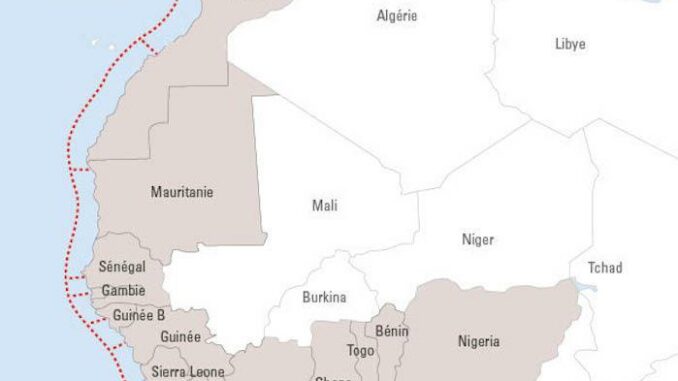
The $25 billion African Atlantic Gas Pipeline (AAGP) Project, launched by King Mohammed VI during his visit to Nigeria in 2016, has reached a major milestone in its development with signing by member countries of ECOWAS of the Intergovernmental Agreement (IGA) related to this mega- energy project expected to transform the whole region.
The signing took place during the ECOWAS Summit held on Sunday in Freetown (Sierra Leone), giving AAGP a new impetus. This regional project is
designed to unlock West Africa’s vast natural gas resources, connect them to major demand centers, integrate African energy markets, and establish a strategic development corridor linking West Africa, Sahel Countries, Morocco, and Europe.
The ECOWAS signing for AAGP gives practical effect to the approval granted at the 66th Ordinary Session of the ECOWAS Summit in Abuja in December 2024. It concludes the institutional process coordinated by ECOWAS following the 2022 MoU sealed between Nigeria and Morocco and reaffirms the participating States’ strong commitment to the project.
A statement issued by Moroccan National Office of Hydrocarbons & Mines (ONHYM) says the milestone reached in Freetown marks the beginning of the next implementation phase, which will include the establishment of the Project Company (SPV), to be headquartered in Casablanca, and the Pipeline Higher Authority (PHA), the governance body of AAGP to be based in Abuja. These institutional bodies will pave the way for investor mobilization and the preparation of the Final Investment Decision (FID).
The final milestone will be marked by ceremony to be held in Morocco, during which the Kingdom and Mauritania will jointly sign the Agreement, in the presence of the President of Nigeria.
Significant progress has already been made, including completion of Front-End Engineering Design (FEED) studies, finalization of route reconnaissance surveys, advancement of environmental and social studies, and establishment of key legal, regulatory, and commercial frameworks.
The AAGP will run from Nigeria to Morocco through thirteen Atlantic coastal countries, with interconnections serving landlocked Sahel nations. Linked to the Maghreb–Europe Gas Pipeline, it will create a new energy corridor with an annual capacity of 30 billion cubic meters (bcm), including up to 15 bcm for exports to Morocco and European markets.
The pipeline will enhance regional gas supply, support electricity generation, drive industrialization, enable value addition to natural resources, and foster new industrial value chains and sustainable employment across West Africa.
Mr. Bashir Bayo Ojulari, CEO of Nigeria’s National Petroleum Company (NNPC) said the signing by the Heads of State of West Africa gives the African Atlantic Gas Pipeline the sovereign foundation it needs to move from vision to delivery.
Head of ONHYM, Mrs Amina Benkhadra, said the event represents another major milestone in the AAGP advancement in line with vision for an integrated Atlantic Africa.
Beyond its energy dimension, the Project embodies a shared African ambition to build a more integrated, industrialized and prosperous continent. By unlocking West Africa’s immense gas resources and connecting them to regional and international markets, the AAGP will strengthen energy security, stimulate industrial development, create new economic opportunities and contribute to sustainable and inclusive growth for future generations.