
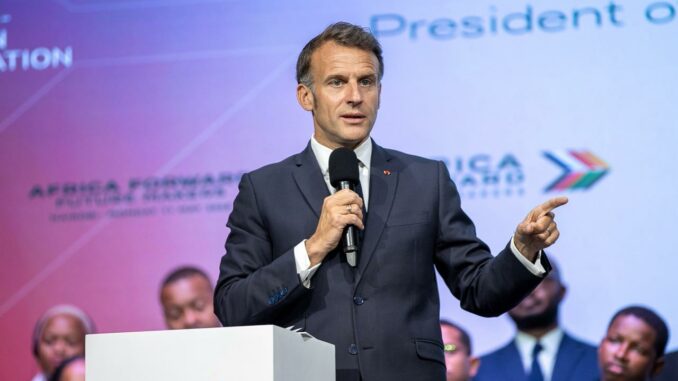
French President Emmanuel Macron delivered one of the most notable diplomatic compliments extended to Morocco in recent years when he described the country’s education system as “an extraordinary model” for the African continent, speaking at the closing session of the Africa Forward “Inspire and Connect” business forum held in Nairobi on Monday.
“What Morocco has done, under the leadership of HM the King, is an incredible revolution,” Macron told the audience, pointing to the country’s performance in primary, secondary, and higher education — and specifically to the strong results achieved by Moroccan graduates at France’s prestigious École Polytechnique — as evidence of a model that other African nations should study and adapt.
The remarks were made in the presence of Prime Minister Aziz Akhannouch, who attended the business forum’s closing session as King Mohammed VI’s representative in Nairobi. Macron also announced 23 billion euros in French investments for Africa in the coming years, a package he said would create more than 250,000 direct jobs across France and the continent, positioning the pledge as emblematic of the new Africa-France partnership model — one built around private-sector investment and mutual economic interest rather than state-to-state aid.
The context of the remarks is significant. Morocco’s education system has been the object of sustained and sometimes difficult reform over the past two decades, with successive national plans attempting to address persistent gaps in learning outcomes, teacher quality, and the connection between the education system’s output and the labor market’s needs. Macron’s framing — citing the results of Moroccan students at an elite French institution as evidence of systemic excellence — captures a real achievement in the upper tier of the educational pyramid, though analysts note that this performance coexists with significant gaps in foundational literacy and numeracy at the primary level across much of the country.
In an analysis of President macron’s remarks, Aujourd’hui le Maroc publication frames them as both a diplomatic recognition and a challenge. In acknowledging Morocco’s educational advances, Macron is effectively endorsing the Royal development model and signaling that Paris views Morocco as a credible partner in the continental education agenda — a role that aligns with Morocco’s recent designation as a reference country by the FAO, the UN Tourism organization, and other multilateral bodies. The recognition is flattering, but it also raises the bar: it obliges Morocco to generalize its successes, measure results without complacency, and ensure that the excellence visible at the top of the educational system reaches the public school classrooms where the majority of Moroccan children are educated.
The Nairobi moment fits within a broader pattern of international validation that Morocco has accumulated in the spring of 2026. The World Bank’s growth and private sector diagnostics, the AfDB’s very satisfactory energy assessment, the FAO’s South-South agricultural cooperation designation, and now Macron’s education tribute collectively reinforce a narrative that Morocco’s development trajectory is attracting serious and sustained external recognition. The challenge, as each of these assessments notes in its own way, lies in deepening and broadening a performance that is strong at the leading edge but still uneven across the full spectrum of the country’s population and territory.