
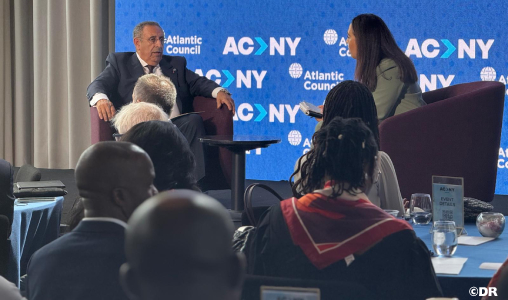
Morocco’s commitment to the African energy sector was highlighted on Tuesday in New York during the Africa Energy Forum (AEF), held on the sidelines of the 80th session of the United Nations General Assembly.
Speaking at the opening of this high-level event, organized by the Atlantic Council, Morocco’s Ambassador to the United States, Youssef Amrani, stressed that the Kingdom’s commitment, both determined and action-oriented, is rooted in the vision of King Mohammed VI.
Citing the large-scale Atlantic African gas pipeline project as an example, the diplomat emphasized the importance of embedding energy initiatives within a perspective of regional integration and solidarity.
This project, he underlined, reflects the shared determination of Morocco and Nigeria to “build a more united, stronger, and more integrated Africa.” “It is not only about transporting gas but about transmitting energy in the noblest sense—energy that fuels growth, connects peoples, and builds bridges between continents,” the diplomat said.
Amrani also noted that this project is “a symbol of effective South–South partnerships, based on trust, solidarity, and shared responsibility.” It is within this framework of tangible cooperation that Africa must assert its unity and strength.
With the technical and environmental studies now completed, the project is entering a new phase involving the upcoming establishment of a specialized entity to oversee its implementation.
The diplomat, who highlighted the geostrategic dimension of this initiative, underlined that “Morocco, by virtue of its position and commitment, stands as a natural gateway to the Atlantic.”
“Thanks to its structuring projects, Morocco positions itself as an advanced energy corridor between Africa and Europe,” he stated, noting that this is a “trajectory that illustrates the Kingdom’s ability to combine political vision, innovation, and cooperation to build an integrated, prosperous, and forward-looking Africa.”
Regarding the continent’s energy future, the ambassador explained that it depends on Africa’s ability to transform its resources into a true driver of inclusive development.
“Energy, when conceived in an inclusive logic, becomes the foundation of positive change. It powers industry, stimulates innovation, creates jobs, and, above all, it changes the lives of millions of Africans,” the diplomat said.