
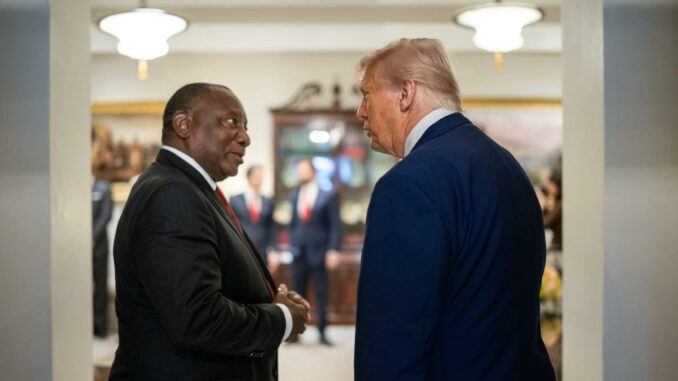
President Donald Trump on Wednesday, November 26, announced that South Africa will not be invited to the 2026 G20 summit scheduled for Miami, Florida, after accusing the country of mistreating a U.S. representative during this year’s meeting.
He further declared an immediate halt to all U.S. payments and subsidies to South Africa, asserting that Pretoria refused to hand over G20 hosting responsibilities to a senior American Embassy official at the close of the Johannesburg Summit.
The United States boycotted the 2025 gathering -the first held in Africa- after Trump reiterated disputed claims that white Afrikaners were facing violent persecution, allegations South Africa has consistently rejected.
President Cyril Ramaphosa’s office described the U.S. stance as “regrettable,” insisting that the handover proceeded at the Foreign Ministry because the United States was absent, and criticized Trump for acting on “misinformation and distortions.”
The row comes as the United States assumes the rotating G20 presidency, leaving uncertainty around the long-term influence of the 2025 Johannesburg declaration, which Washington refused to sign due to objections over climate-related priorities.
Trump has increasingly targeted South Africa since returning to office, citing its diplomatic ties with China, Russia and Iran, and advancing claims about attacks on Afrikaner farmers — assertions dismissed by the South African government and many analysts.
His administration has also restricted U.S. refugee admissions to 7,500 annually, reserving most places for white South Africans after reopening the programme he suspended in January. With deep historic tensions surrounding Afrikaner identity and apartheid-era legacies, the latest developments have amplified diplomatic friction between Washington and Pretoria.