
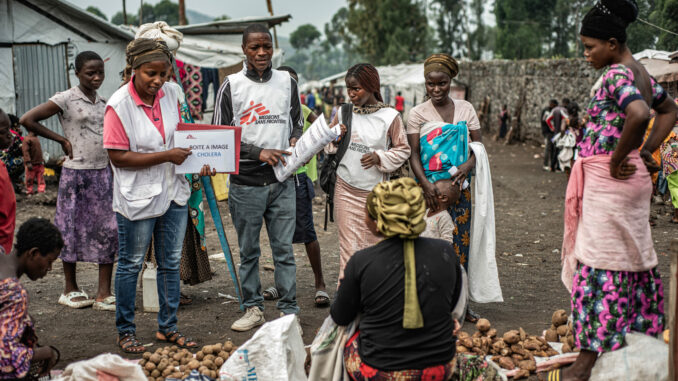
The Democratic Republic of Congo is contending with its most severe cholera outbreak in a quarter of a century, with nearly 2,000 deaths recorded since January, the United Nations Children’s Fund (UNICEF) has warned on Monday, December 8.
In a new situation report, the agency described a rapidly escalating public health emergency driven by widespread gaps in water and sanitation infrastructure, ongoing conflict and limited financial resources. UNICEF confirmed 64,427 cases and 1,888 fatalities nationwide, with children accounting for almost a quarter of infections.
At least 14,818 children have fallen ill, and 340 have died, underscoring the disproportionate impact on younger populations. The disease has now spread to 17 of the country’s 26 provinces, including the conflict-stricken eastern regions and densely populated urban centres such as Kinshasa.
The Agency highlighted a particularly devastating episode in a Kinshasa orphanage where 16 out of 62 children died within days of the outbreak.
“Congolese children should not be so gravely affected by what is a wholly preventable disease,” UNICEF spokesperson John Agbor said, calling for urgent, coordinated interventions to prevent further loss of life.
Despite government efforts -including a $192 million national elimination plan- the response remains severely underfunded. UNICEF has appealed for $6 million in 2026 to sustain rapid-response operations, warning that delays in financing could lead to an even greater humanitarian toll. Agbor cautioned that “without additional funds and coordinated action, many more lives could be lost.”
Cholera, transmitted through contaminated water, spreads quickly in environments with poor sanitation — a reality for millions across the DRC. Only 43% of Congolese have access to basic water services, the lowest rate on the continent, while just 15% have access to sanitation facilities. Years of insecurity and displacement in the mineral-rich east have further weakened the country’s already fragile systems.
The outbreak reflects a wider continental resurgence, with African health authorities reporting rising case numbers in several countries, including Angola and Burundi, and a 30% regional increase compared with the previous year. UNICEF is urging donors, regional partners and the international community to scale up support, warning that without swift action, the DRC faces a prolonged and catastrophic public health crisis.