
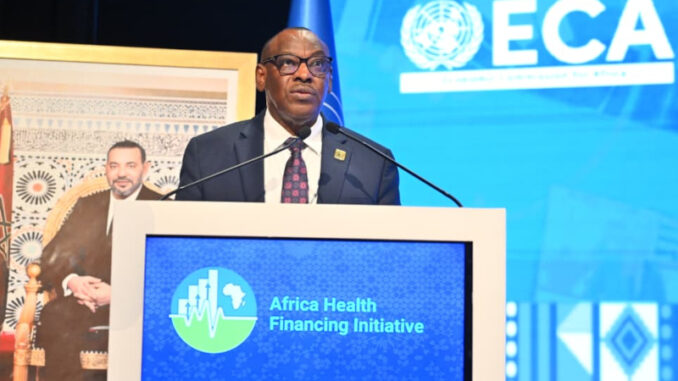
The Chief of Staff of the United Nations Economic Commission for Africa (UNECA), Aboubakri Diaw, presented on Friday in Tangier the Initiative on Sustainable Health Financing in Africa, which includes eight commitments aimed at strengthening the resilience and sustainability of health systems across the continent.
Speaking on the sidelines of the Conference of African Ministers of Finance, Planning and Economic Development (COM 2026), organized as part of the 58th session of the ECA, Diaw emphasized that this initiative seeks to drive a structural transformation in health financing in Africa by mobilizing political and technical leadership in support of the 2030 and 2063 agendas.
In this regard, he specified that the eight commitments of the Initiative focus in particular on strengthening domestic resource mobilization for autonomous and sustainable health system financing, as well as improving coordination between the Ministries of Health, Finance, and Planning.
These commitments also include promoting a paradigm shift that views health as a strategic economic investment rather than merely a social expenditure, along with enhancing the resilience of health systems to current and future shocks.
They further address the promotion of regional integration within the framework of the African Continental Free Trade Area (AfCFTA) as a financing lever, as well as mobilizing sustained support from African and international partners.
Diaw also highlighted the structural challenges facing the continent, noting that less than 41% of health expenditures are financed by African governments, while more than 40 million people remain excluded from national health coverage systems.
He further pointed out that most African countries do not meet the target of allocating 15% of public budgets to health, as set by the Abuja Declaration, adding that the sector’s annual financing gap is estimated at $66 billion.
In this context, he stressed the need to resort to innovative financial instruments, citing in particular debt-for-health swap mechanisms, levies on certain products, bonds targeted at the diaspora and investors, as well as blended finance mechanisms aimed at reducing investor risk.
He also underscored the urgency of moving to a phase of concrete implementation, noting that the tools already exist, but the main challenge now lies in deploying them at scale through stronger coordination and increased financial discipline.
The presentation of this initiative builds on work undertaken during the high-level forum on sustainable health financing in Africa, recently held as part of COM 2026 (March 28–April 3 in Tangier), with the participation of African government officials and leaders of international institutions.
This major continental event, held under the theme “Investing in Africa’s Health,” aims to accelerate resource mobilization and drive structural reforms for sustainable health system financing in Africa.