
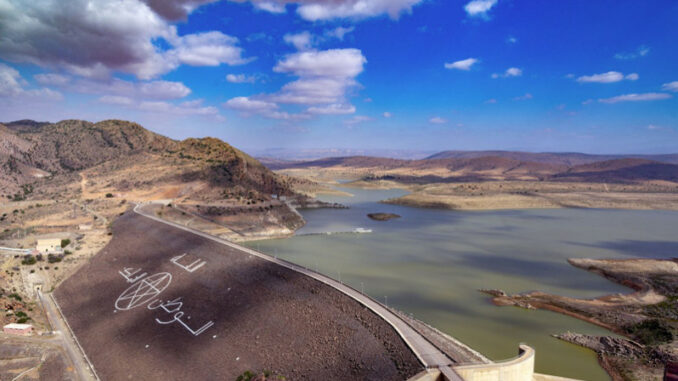
Morocco’s water reserves experienced dramatic improvement following late December rainfall, with dams gaining over 400 million cubic meters between December 22 and 26, pushing the national filling rate to 36%, according to official figures from the Ministry of Equipment and Water.
Recent precipitation waves generated exceptional water resource improvement. Official data relayed by platform Maa Dialna shows total reservoir volumes jumped from 5.637 billion cubic meters to 6.046 billion, representing net increase of 409 million cubic meters within just four days. This performance enabled the national filling rate to cross the 36% threshold, marking significant increase from the previously recorded 33.6%.
The pace proved particularly intense, contrasting sharply with earlier slowness when the December 10-15 period generated only modest 105 million cubic meter gains. The rainfall impact manifested acutely across major hydraulic infrastructure. Al Wahda dam, a supply pillar with colossal capacity, saw reserves enriched by 105.7 million cubic meters, bringing its level to 1.617.9 billion and filling rate to 45%.
Other reservoirs display enviable situations. Sidi Mohammed Ben Abdellah dam distinguished itself with 86% filling rate following substantial 69.5 million cubic meter increase. Oued El Makhazine confirmed favorable resource management, reaching 83% capacity after accumulating additional 45.7 million cubic meters.
However, improvement remains uneven, revealing contrasting situations within the network. While Idriss I recorded notable 31.7 million cubic meter progression bringing its rate to 37%, and other dams including Ahmed El Hansali and Dar Khrofa benefited from these gains, Al Massira’s case remains concerning. Despite its scale, the dam experienced only slight 5.5 million cubic meter increase, maintaining critically low 3% filling rate.
Specialists caution against premature optimism. This progression, though encouraging, cannot alone compensate accumulated effects of several years’ water deficit. While recent dynamics illustrate dams’ rapid recharge capacity under favorable climate conditions, this cannot be interpreted as durable relief from water stress, with future trajectories remaining closely dependent on upcoming precipitation rhythm and regularity.