
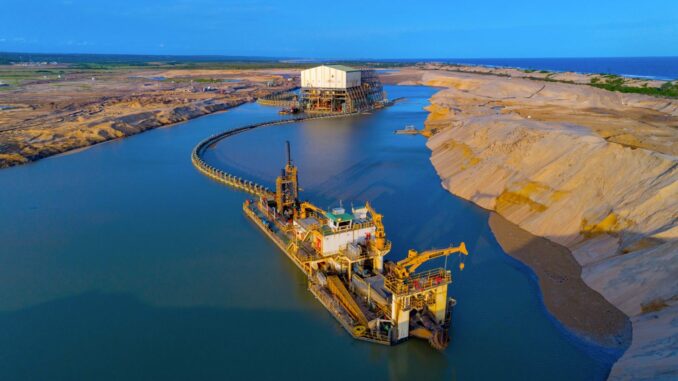
Mozambique has tightened on June 4, its regulatory grip over the extractive sector after President Daniel Chapo signed sweeping legislation mandating state participation in all mining ventures and enforcing domestic mineral processing requirements.
The reform, reported by TRT Afrika, introduces a minimum 15 percent free-carried and non-dilutable state stake—held through the National Mining Company—in all mining projects across the value chain. The policy marks a decisive recalibration of resource governance, aligning mineral exploitation with national development priorities.
Under the new legal framework, Mozambique also moves to prohibit the export of unprocessed or semi-processed minerals, except where specific ministerial authorization is granted under approved industrialization plans. The measure is designed to deepen value addition within the country and reduce reliance on raw commodity exports.
Government authorities describe the legislation as a strategic assertion of economic sovereignty, aimed at strengthening control over critical resources at a time when global demand for battery minerals—particularly graphite—continues to accelerate. Mozambique, one of the world’s leading graphite producers, sits at the centre of this shifting energy-transition supply chain.
The law, already approved by parliament in May, forms part of a broader policy thrust to reposition the country from a raw exporter to an integrated processing hub, leveraging its significant reserves in graphite, rubies, and coal. Analysts note that while the reform signals long-term industrial ambition, key operational questions remain—particularly regarding its application to existing long-term mining agreements and investor protections.
In essence, the policy reflects a broader continental trend: African states tightening regulatory frameworks to secure a greater share of resource wealth, while attempting to anchor extraction within domestic industrial ecosystems. A quiet but firm line has now been drawn—between extraction and transformation, between export dependency and industrial self-determination.