
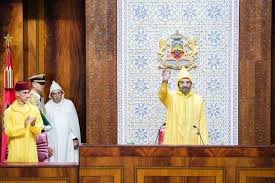
King Mohammed VI has stressed again the importance of greater social and territorial equity that the Kingdom has embarked on achieving, pointing out that the level of local development is the mirror that truly reflects the progress of the emerging, united Morocco.
This came in a speech delivered by the Monarch at the opening of the fall session of the Moroccan parliament on Friday.
“In this regard, I seek to ensure everyone benefits from the fruits of growth, and from equal opportunities among the citizens of our unified country, when it comes to political, economic, social, and other rights,” said the King after he pointed out that thanks to the dynamics he set in motion, Morocco has embarked on achieving greater social and territorial equity.
“Achieving social justice and combating inter-regional disparities are not empty slogans, nor do they constitute a temporary priority whose importance may decline depending on circumstances. Rather, I view this as a strategic policy objective to which all actors must adhere; it is a vital, core element which must govern and determine all development policies,” the Monarch argued.
He insisted in this connection that the efforts made by emerging Morocco to achieve social and inter-regional equity today require mobilization of all of the nation’s energies.
The major shift to achieve concerning local development necessitates a tangible change in mentalities and work methods, and requires actual consolidation of a result-oriented culture that is based on accurate field data as well as on the use of digital technology,” King Mohammed VI said, calling for a faster implementation pace and stronger impacts from the next-generation local development programs and making sure urban and rural areas equally benefit from these programs.
He mentioned in this regard, the key priority areas identified, especially the promotion of local initiatives and economic activities, the creation of job opportunities for young people, and the achievement of tangible progress in the education and health sectors, as well as local rehabilitation policies.
He called on everyone – each from their position – to combat all practices that squander time, effort, and resources. “Indeed, one cannot be complacent when it comes to the effectiveness and return on public investment,” he outlined.
The King then urged all stakeholders to give special attention to the most fragile areas, taking into account their specificities and the nature of their needs, especially in mountainous regions and oases.
Harmonious local development cannot be achieved without effective integration and solidarity between regions and areas. It is necessary, today, to reconsider the development policy for mountainous regions, which account for 30% of the national territory. We need to come up with an integrated public policy for these regions – one that takes into account their specificities as well as their numerous resources, the Monarch argued, stressing also the need to achieve the optimal use of sustainable development mechanisms regarding the coastline, including the Coastal Law and the National Coastal Plan.
The goal is to strike the required balance between the rapid development of these areas, the need to protect them, and the valuation of their enormous potential, within the framework of a national maritime economy that creates wealth as well as job opportunities, he explained.
The king likewise stressed the need to expand the scope of the emerging rural centers program as a suitable mechanism for the management of urban expansion and the mitigation of its adverse effects. These emerging centers will also serve as an effective link for bringing administrative, social, and economic services closer to citizens in rural areas.
The Monarch also insisted that “there should be no inconsistency or competition between national flagship projects, on the one hand, and social programs, on the other, since the goal is to achieve the country’s development and improve the living conditions of citizens, wherever they may be.”
In the same respect, the King added that special attention should be given to accompanying citizens, and shedding light on initiatives taken by public authorities as well as the various laws adopted and the decisions made, especially those relating directly to the rights and freedoms of citizens.
This matter is not the responsibility of the government alone, the Monarch stressed, explaining that “although it is everyone’s responsibility, it is, first and foremost, your duty as parliamentarians, given that you represent the citizens.”
“This is also the responsibility of political parties, elected officials serving on boards and councils at all territorial levels, the media, civil society organizations, and the life force of the nation,” King Mohammed VI said.