
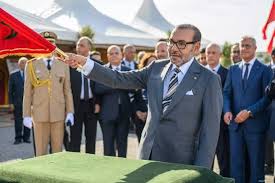
King Mohammed VI, accompanied by Crown Prince Moulay El Hassan, chaired, on Monday in Nouaceur, the presentation ceremony and launch of construction works of Safran Group’s “aircraft engines” industrial complex that will strengthen further Morocco’s aeronautics industry.
This facility will be dedicated to aircraft engines assembling, testing, maintenance and repair activities for new-generation engines. It shows the strong partnership set between Safran and Morocco to propel the Kingdom’s aerospace sector to higher levels of technological competitiveness.
At the outset of the ceremony, a corporate film was screened, tracing the development of the aeronautics sector, one of Morocco’s global industries, in recent years, thanks to the bold reforms and structuring projects initiated by the Sovereign.
On this occasion, the minister of Industry and Trade, Ryad Mezzour, made a presentation before the Sovereign saying that that thanks to the royal vision Morocco has established itself as a key global destination in cutting-edge sectors and built a world-class aerospace industry.
The sector’s export revenue has significantly risen, “going from less than MAD 1 billion in 2004 to exceeding MAD 26 billion in 2024,” Mezzour said, stressing that the aeronautic ecosystem has more than 150 companies, including the world’s largest operators.
Safran Group, a long-standing partner of the Kingdom for 25 years, is today renewing its confidence in the Moroccan platform through the implementation of a world-class integrated complex for the assembly, testing, maintenance, and repair of aircraft engines, said the minister, noting that this involves the establishment of an aircraft engine maintenance and repair plant (MAD 1.3 billion), with a maintenance capacity of 150 engines per year, creating 600 direct jobs by 2030.
It also involves the development of an assembly and testing plant for LEAP 1-A commercial aircraft engines, which are used in particular in Airbus A320 Neo aircraft models, Mezzour said.
With an assembly capacity of 350 engines per year, this MAD 2.1 billion investment will generate 300 highly skilled jobs by 2029. As the second production site for the LEAP-1A engine worldwide, this project will establish the Kingdom in the global value chain of aircraft engine manufacturers and will attract new equipment manufacturers to Morocco national ecosystem
For his part, the Chairman of Safran Group’s Board, Ross McInnes, said the presence of the King in the ceremony is deeply meaningful for the group, noting that it shows the Sovereign’s interest in the Kingdom’s industrial development.
He also underlined the excellent economic and industrial ties between France and Morocco, assuring that his “Group does not produce in Morocco but with Morocco,” a country that is strategic for Safran in several fronts.
Safran CEO Olivier Andriès said the group’s decision to build Safran’s new aircraft engine industrial complex in Morocco was not accidental, noting that his group had “chosen a country with talent, modern infrastructure, and a stable macroeconomic environment.”
“But above all, we have been guided by the trust inspired by the momentum driven by Your Majesty to turn the Kingdom into a competitive industrial platform on a global scale,” he said.
“Today these two projects and ongoing extensions in three of our other sites amount to an investment of more than €350 million and are set to generate thousands of jobs for the entire aerospace ecosystem in the Kingdom,” underlined Mr. Andriès.
Afterwards, King Mohammed VI chaired the signing ceremony of three agreements. The first is a protocol agreement the Moroccan State and the Safran Group, for the installation of the French group’s aircraft engine assembly and testing plant.
The second is a memorandum of understanding on the supply of renewable energy to Safran sites. The third agreement is related to the establishment of the Safran Group’s aircraft engine assembly and testing plant at Midparc, Nouaceur industrial zone.
Afterwards, King Mohammed VI posed for a souvenir photo with a group of young people training at the Institute of aeronautical professions in Nouaceur to join the future aircraft engine maintenance plant, before launching the construction works of the Safran group’s “Aircraft Engines” industrial complex.