
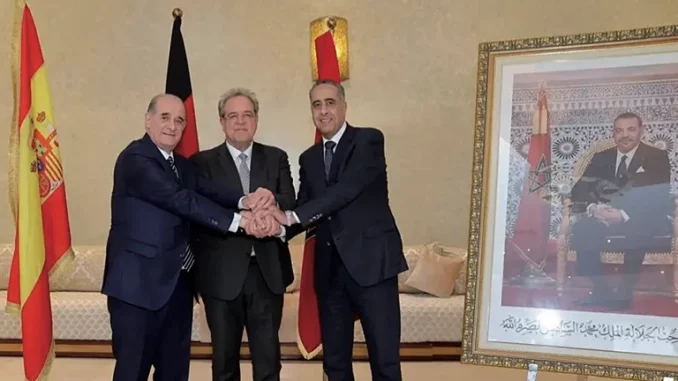
A high-level security summit held in Rabat from January 7-9, 2026, has formalized a groundbreaking tripartite security alliance between Morocco, Spain, and Germany. The meeting brought together the top security chiefs from all three nations and represents a significant evolution from traditional bilateral agreements toward a robust multilateral architecture designed to address shared security challenges across the Mediterranean region.
The summit, led by Morocco’s Abdellatif Hammouchi, Spain’s Francisco Pardo Piqueras, and Germany’s Dieter Romann, builds on foundations established at a previous meeting in Madrid in January 2025. The three directors agreed to unprecedented operational coordination focused on combating terrorism, organized crime, cybercrime, irregular immigration, and drug trafficking. Morocco’s strategic geographic position and internationally recognized intelligence capabilities position it as a critical security gateway for European stability.
Real-time intelligence sharing between Rabat, Madrid, and Berlin now enables the three countries to anticipate threats and dismantle dormant cells before they can reach European territory. The partnership specifically targets criminal networks exploiting regional instability, with coordinated approaches to dismantling human trafficking operations, securing maritime and land routes against narcotics flows, and protecting critical infrastructure from cyber threats.
An innovative dimension of the partnership focuses on security management for major international sporting events. With Morocco, Spain, and Germany set to co-host the 2030 World Cup, the three nations have identified sports security as a priority requiring cutting-edge expertise. The Rabat meeting coincided with the 2025 Africa Cup of Nations in Morocco, allowing Spanish and German experts to observe Moroccan crowd management protocols and security perimeters firsthand.
Delegates visited the African Police Cooperation Center, a state-of-the-art facility demonstrating Morocco’s capacity to centralize tactical information and coordinate real-time interventions with surgical precision. The partnership includes systematic sharing of advanced surveillance tools, including AI applications for security purposes, and establishes institutionalized regular meetings to ensure long-term strategic continuity rather than sporadic cooperation.