
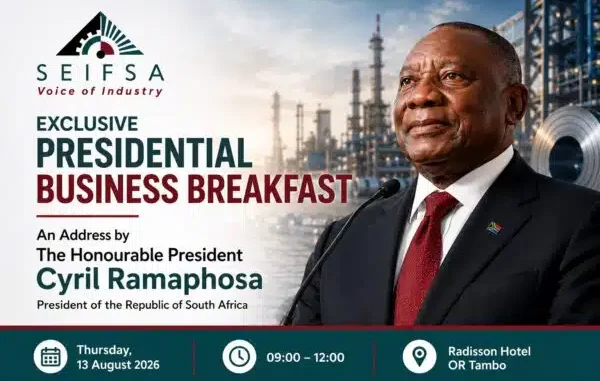
South African President Cyril Ramaphosa has said the country’s massive infrastructure investment programme must be used to rebuild its industrial base, expand manufacturing, develop skills and create jobs.
Speaking at the Steel and Engineering Industries Federation of Southern Africa (SEIFSA) Presidential Business Breakfast in Johannesburg on Thursday, August 13, 2026, he said South Africa was entering one of its most significant periods of infrastructure investment and economic reform since the advent of democracy.
Ramaphosa said the Government’s infrastructure programme, worth about R1 trillion over the next three years, should be treated as an industrial strategy rather than simply a construction programme.
He called for roads, railways, ports, transmission lines and water systems to generate demand for locally manufactured equipment and components. He acknowledged the challenges facing manufacturers, including weak domestic demand, logistics constraints, high electricity costs, infrastructure bottlenecks and rising import competition, warning that these pressures were putting factories and jobs at risk.
On electricity, the President said the end of load shedding was a major achievement but stressed that power must also become more affordable, particularly for energy-intensive industries. He said the South African Wholesale Electricity Market is expected to begin operating in 2027, with greater competition among generators.
He also announced the establishment of an Eskom Restructuring Task Team to oversee the creation of an independent, state-owned transmission company. Ramaphosa said South Africa’s energy transition should simultaneously become an industrial transition, with opportunities to manufacture transformers, cables, towers, switchgear, batteries and other equipment domestically.
The President also highlighted opportunities in rail, ports and water infrastructure. South Africa requires about 14,000 kilometres of new transmission lines over the next decade, which he said could create substantial demand for steel, electrical equipment, engineering services and logistics.
He called for the rebuilding of domestic railway manufacturing capabilities, including locomotives, wagons and signalling equipment, while water-sector investments could stimulate demand for pipes, pumps, valves and treatment equipment. He further urged government to provide industry with a clearer infrastructure pipeline covering the next five, 10 and 15 years to give businesses confidence to invest.
Ramaphosa described steel as a strategic national industry and said government, business and labour must work together to restore manufacturing capacity, develop skills and expand exports. He called for infrastructure contracts to include measurable targets for apprenticeships, artisan training, young engineers and local suppliers. With the African Continental Free Trade Area creating access to a market of more than one billion people, he said South Africa should position itself as the engineering workshop of Africa, exporting machinery, transformers, railway equipment, fabricated steel and engineering expertise. He said the infrastructure programme must ultimately become the foundation of a new era of industrialisation, with South Africa producing and exporting more while creating productive jobs for generations to come.