
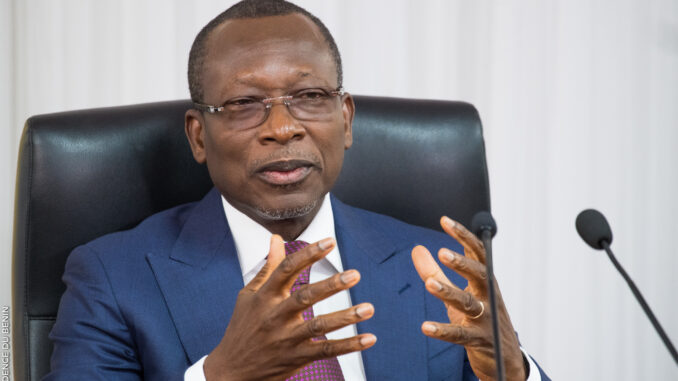
After a decade in Office, the Presidency of Benin leader Patrice Talon is drawing to a close, with the outgoing Head of State preparing to hand over power on Sunday, May 24, 2026, amid a national moment of reflection on his governance record.
According to a report by Radio France Internationale, President Talon chaired his final Cabinet meeting on Wednesday, May 20, in Cotonou, as Government officials outlined key achievements and controversies that have defined his Administration.
Government spokesperson Wilfried Houngbédji highlighted administrative decisions including recent layoffs at the public broadcaster SRTB, which affected 169 employees. While the government defended the restructuring as part of broader reforms, it acknowledged the human impact of the decision.
On the broader governance record, officials presented a largely positive assessment of economic and institutional reforms undertaken over the past ten years, arguing that structural changes have modernised key sectors of the state and strengthened administrative efficiency.
However, the administration’s political reforms have remained a point of contention, with critics questioning their democratic implications. In response, the presidency defended its approach, arguing that democratic models must be adapted to national contexts rather than imported wholesale.
Attention has also turned to political detainees, including figures such as Reckya Madougou and Joël Aïvo, with speculation mounting over the possibility of a presidential pardon before the transition of power. The government spokesperson suggested that developments remain possible in the final hours of the outgoing administration, without confirming any decision.
As Benin approaches the leadership transition, the national mood reflects both institutional continuity and unresolved political tensions, encapsulating a decade of reform-driven governance that has reshaped the country’s political and administrative landscape while leaving open questions about civil liberties and political pluralism.
In essence, Talon’s departure marks not just the end of a Presidency, but the closing of a defining chapter in Benin’s contemporary statecraft—where reform, restraint, and political recalibration have moved in constant, and sometimes uneasy, balance.