
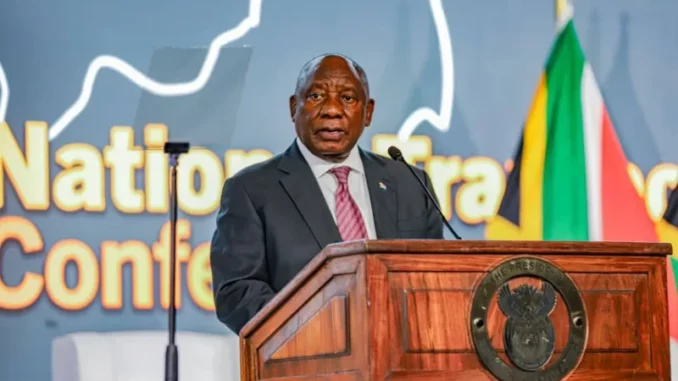
President Cyril Ramaphosa has declared that South Africa’s inaugural National Transport Conference should mark a decisive turning point for the country’s transport and logistics sector, urging stronger collaboration between Government, business and labour.
Speaking at the Gallagher Convention Centre on Monday, March 16, he emphasised that building an efficient and resilient transport system requires sustained partnerships across multiple sectors.
The President proposed the establishment of a permanent Transport Council to institutionalise cooperation among key stakeholders.
According to him, the Council would bring together Government, private sector players, and passenger and logistics service providers across land, air and sea transport to drive reforms and strengthen coordination within the sector.
Highlighting the economic significance of transport, Ramaphosa noted that inefficiencies in logistics are costing the country nearly R1 billion daily. He stressed that a functional transport system is critical to economic growth and improved livelihoods, warning that inefficiencies increase costs and limit opportunities, while seamless systems enable national progress.
He outlined ongoing government interventions under the Medium-Term Development Plan, including the implementation of the National Rail Policy of 2022 and the National Freight Logistics Roadmap of 2023. These initiatives aim to restore rail as the backbone of freight transport.
Through the Transnet Rail Infrastructure Manager, train slots covering 24 million tonnes of freight annually have been allocated to 11 operators, with the first private operator expected to commence operations in April 2027. Government also targets moving 250 million tonnes of freight by rail by 2029, up from 160 million tonnes recorded in the past financial year.
Ramaphosa further pointed to early improvements driven by the National Logistics Crisis Committee, which has been addressing bottlenecks in the freight system. He maintained that a modern transport network would reduce the cost of doing business, attract investment, create jobs and enhance regional integration. The conference, he added, offers stakeholders an opportunity to position transport at the centre of South Africa’s economic growth and development agenda.