
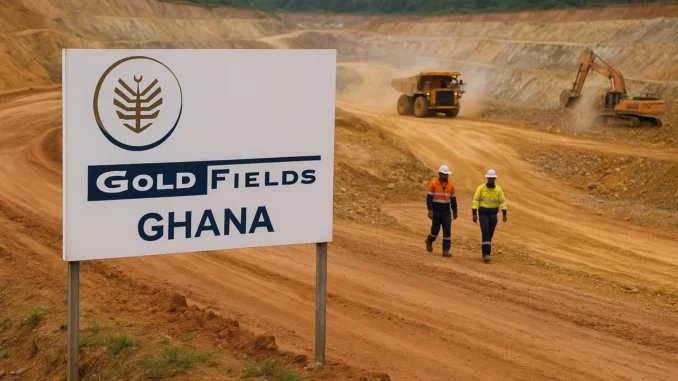
The Ghana Chamber of Mines has defended Gold Fields’ application to extend its Tarkwa mining lease, warning that any abrupt departure from Ghana’s private investment-led mining model could weaken investor confidence and threaten long-term sector stability.
At a press briefing on Thursday, May 14, the Chamber rejected calls by the Institute of Economic Affairs (IEA) for the Government to deny the lease renewal when the current concession expires in 2027.
The debate has intensified into a wider national discussion over resource nationalism, indigenous participation and the future structure of Ghana’s mining industry amid record-high global gold prices.
Chief Executive Officer of the Chamber, Kenneth Ashigbey, argued that the Tarkwa mining enclave remains one of Ghana’s most significant sources of public revenue. According to him, Gold Fields, Ghana Manganese Company and AngloGold Ashanti’s Iduapriem mine collectively paid about GH¢5.1 billion in taxes in 2024, representing approximately 7.3 per cent of the Ghana Revenue Authority’s direct domestic tax collections.
The Chamber’s position follows comments by former Chief Justice Sophia Akuffo, who spoke on behalf of the IEA and urged government not to renew Gold Fields’ lease. She argued that Ghana now has the technical expertise and indigenous firms capable of independently managing large-scale mining concessions.
Akuffo cited local companies such as Engineers and Planners, Heath Goldfields Limited and Rocksure International Limited as examples of indigenous firms already undertaking major mining operations.
However, the Chamber insisted that Ghana’s history under state-led mining operations demonstrated the risks of nationalization, citing operational inefficiencies and declining output during the era of the former State Gold Mining Corporation.
Mr Ashigbey also rejected suggestions that multinational firms disproportionately benefit from Ghana’s mineral wealth, arguing that the current fiscal framework allows the state to capture more than 60 per cent of mining rents through royalties, taxes and levies.
He credited mining sector reforms introduced in the 1980s with restoring investor confidence and increasing large-scale gold production from about 216,000 ounces in 1983 to nearly three million ounces in 2025, helping Ghana maintain its status as Africa’s leading gold producer.
Despite defending multinational mining firms, the Chamber acknowledged concerns over underdevelopment in mining communities and called for reforms that would allocate at least 30 per cent of mineral royalties directly to host communities.
The Chamber also advocated a mining revenue management framework similar to Ghana’s petroleum revenue system to improve transparency and local development outcomes.
According to the Chamber, the Gold Fields Ghana Foundation has invested more than 100 million U.S. dollars in education, healthcare, roads, agriculture, water and sanitation projects since 2002, including the redevelopment of the Apinto Government Hospital and construction of roads in Tarkwa and Damang.