
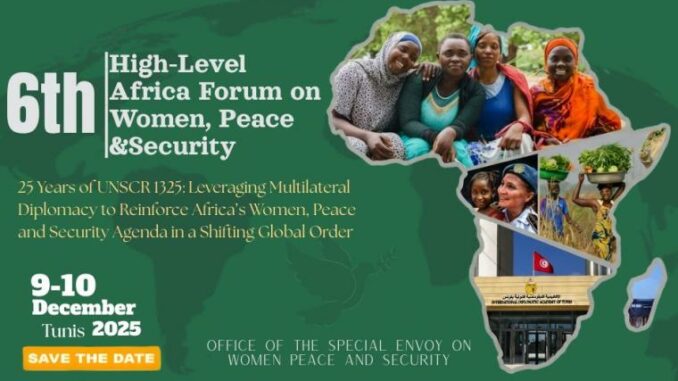
The sixth African High-Level Forum on Women, Peace and Security opened in Tunisia on Tuesday, December 9, with a strong call for enhanced multilateral cooperation to address the continent’s shared peace and security challenges.
The Forum, organized by the African Union (AU), was held under the theme: “25 Years of UNSCR 1325: Leveraging Multilateral Diplomacy to Reinforce Africa’s Women, Peace and Security Agenda in a Shifting Global Order.”
In his opening remarks, delivered via video message, Chairperson of the African Union Commission, Mahmoud Ali Youssouf, paid tribute to the women of Sudan, standing firm amid conflict; the women of the Great Lakes region, persevering in protracted crises; and the women of the Sahel, who sustain communities despite insecurity and displacement. “Their resilience reminds us that women are central pillars of peace and stability,” he stressed, reaffirming the Commission’s unwavering commitment to the progress of this agenda, pledging to work in close collaboration with Member States, Regional Economic Communities, civil society, and partners to ensure that “our collective commitments deliver meaningful and measurable impact for women and girls.”
Looking ahead, the Chairperson of the Commission stressed that the collective focus must shift to accountability, financing, and women’s leadership. He noted that the confluence of the 16 Days of Activism, the G20 declaration, and the adoption of the AU Convention on Ending Violence Against Women and Girls (CEVAWG) provides powerful momentum. This momentum, he urged, must be translated into concrete action that strengthens protection systems, deepens women’s participation in decision-making, and ensures that peace and security processes across Africa are truly inclusive.
The AUC Chairperson’s Special Envoy on Women, Peace and Security, Liberata Mulamula, asserted that Africa’s strength is rooted in solidarity, multilateralism, and collective action. She called for a renewed commitment to operationalizing WPS obligations, cautioning against backsliding, and emphasizing the necessity of ensuring that women’s voices—from grassroots communities to national leadership—shape policy and drive implementation.
Ambassador Mulamula highlighted the urgent need for accelerated ratification of the AU Convention on Ending Violence Against Women and Girls (CEVAWG), noting that to date, only seven countries have signed the convention, while rapid ratification remains essential. Ultimately, she conveyed the expectation that the Forum will produce transformative, forward-looking outcomes to guide the next decade of the WPS agenda (2025–2035), building on past achievements while decisively tackling emerging challenges.
Several other speakers explained how conflicts continue to disproportionately impact women, who bear the primary burden of displacement and insecurity, calling on Member States and partners to expose and dismantle the economic systems that fuel instability, and to redirect political and financial resources toward achieving sustainable peace and human security. They also stressed the need to amplify the often-overlooked contributions of women who serve as “silent architects of peace.”
They underscored that sustainable peace hinges on strong prevention mechanisms, effective early mediation support, and the meaningful participation of women in all peace processes, calling for an immediate end to decision-making about women but without women, and stressing that policies disconnected from everyday realities cannot lead to lasting peace. However, despite challenges such as shrinking resources and narrowing democratic space, African women continue to play vital roles as community leaders, mediators, and defenders of human dignity