
Understanding the evolutionary history of Homo sapiens, Neanderthals, and Denisovans has relied for decades on morphological, genetic, and archaeological analyses from numerous European and African sites. While paleogenetic data situate the last common ancestor of these lineages between 765,000 and 550,000 years ago, its geographic location and morphological characteristics remained uncertain until recently.
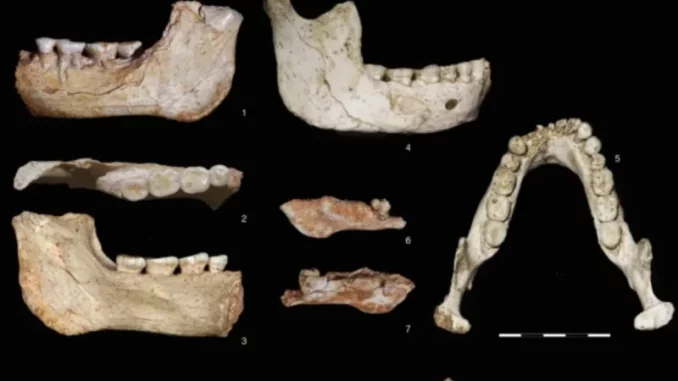
A new study co-directed by Abderrahim Mohib from INSAP, Rosalia Gallotti from Paul-Valéry Montpellier University, and Camille Daujeard from France’s National Museum of Natural History analyzes hominin fossils unearthed in the Hominid Cave at Thomas Quarry I in Casablanca. These remains—teeth, jaw fragments, and vertebrae—were dated to approximately 773,000 years ago using methods based on Earth’s magnetic field inversion occurring during that period.
The fossils display singular morphology combining primitive traits with derived characteristics recalling both later Homo sapiens and certain archaic Eurasian hominins. Researchers suggest they probably belong to an evolved form of Homo erectus sensu lato in North Africa, comparable in some aspects to Europe’s Homo antecessor. However, notable differences exist between Moroccan and Spanish fossils, with Casablanca and Atapuerca specimens sharing several dental and mandibular characteristics while showing marked regional differentiation already evident during that era.
These results illuminate African populations substantially predating the oldest Homo sapiens fossils discovered at Jebel Irhoud, also in Morocco, dated to 300,000 years ago. They constitute solid proof of an ancestral African lineage to our species. Paleoanthropologist Jean-Jacques Hublin, the study’s principal author, notes these discoveries fill a “gap in the African fossil record” concerning this key human evolution period.
The site, discovered in 1969 on Casablanca’s Atlantic coast, was intermittently occupied by hominins using Acheulean stone tool traditions while also serving as carnivore dens. The Casablanca hominins’ morphology situates them near the separation between African and Eurasian lineages, reinforcing evidence that divergence between the Homo sapiens lineage and that of Neanderthals and Denisovans began earlier than previously thought, possibly between 750,000 and 550,000 years ago.